
West Asia war adds jitters, but India still seen as attractive long-term bet: former World Bank Miga CEO Honda
The war in West Asia has brought global investors to terms with bringing geopolitical risk into their calculations, no longer treating such shocks as infrequent ‘tail risks’. Despite fresh jitters shaking up emerging markets, India remains a major beneficiary of shifting capital as investors seek stability in the midst of the turbulence.
Keiko Honda, a board member at Mitsubishi UFJ Financial Group (MUFG) and former chief executive officer of the World Bank Group’s Multilateral Investment Guarantee Agency (Miga), said the current volatility is changing the way risk premiums are calculated. Investors are now weighing the probability of conflict directly against projected cash flows, a shift that favours India’s comparatively insulated state.
While India’s transition to a middle-income economy has made it less dependent on multilateral aid and more attractive for foreign direct investment (FDI), Honda warned that stability is only half the battle won. The continuation of capital inflows will depend more on corporate governance standards and the ability of boards to guide the company towards long-term value creation. “India is seeing stronger investor interest, partly because its geopolitical risk profile is comparatively favourable versus regions like the Middle East or Eastern Europe,” she said.
With aging populations stalling growth in Japan and China, India’s edge in demographics could provide an advantage. Her observations draw partly from her work with the United Nations Investment Management Committee, where population trends are closely tracked.
However, Honda said the ‘demographic dividend’ needs to be accompanied by institutional strength and a corporate shift towards long-term strategy and sustainable Environmental, Social, and Governance (ESG) frameworks. The “social” component of ESG, she said, now effectively captures geopolitical instability, making it central to how investors evaluate countries and companies.
“Boards should not micromanage management decisions. Their role is to provide oversight, strengthen governance, and ensure sustainable growth,” she said.
She pointed to Japan’s ongoing corporate governance transition as a useful reference point. With a growing share of listed equities now held by foreign investors, Japanese firms are increasingly focused on improving transparency and long-term cash flows to attract global capital. The key lesson, she said, is that investors will commit large pools of capital only when companies can credibly demonstrate sustained value creation.
On India’s financial sector, Honda was upbeat, stating that multiple overseas financial institutions continue to study opportunities in the country. MUFG completed the acquisition of a 20% stake in the non-banking finance company Shriram Finance Ltd recently.
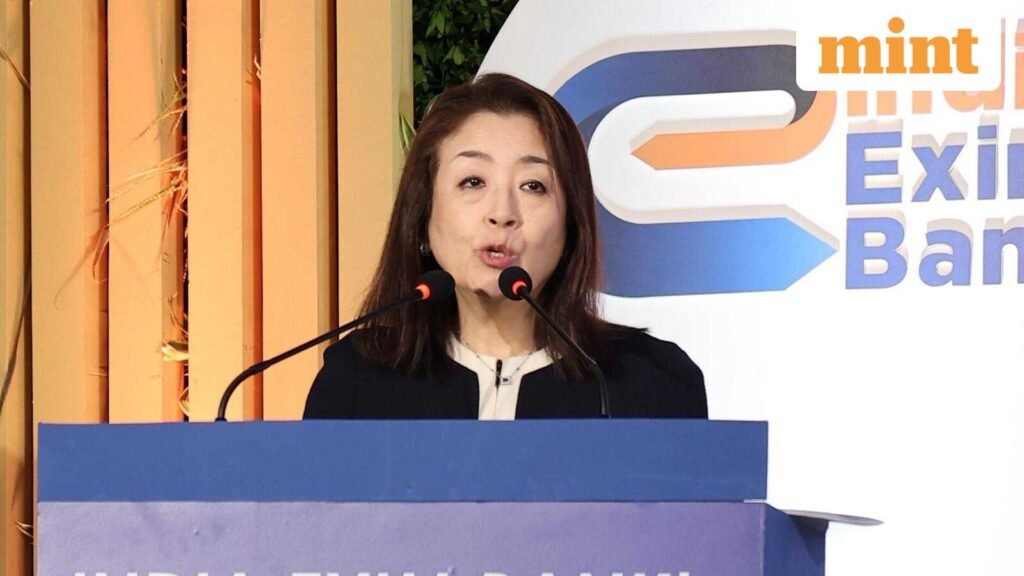
Honda was visiting India to deliver Exim Bank’s Commencement Day Lecture on the theme of Sustainable Investing.
She cautioned that even if current conflicts de-escalate, markets are unlikely to revert to the earlier equilibrium. “We now know such extreme geopolitical events can happen. That understanding will remain embedded in future investment decisions,” she said, indicating that risk premiums could stay structurally higher.
On the role of multilateral finance and blended capital, Honda offered a measured view. While there have been calls to scale up blended finance to crowd in private investment into developing economies, she said public capital must be deployed carefully. “It should not crowd out private investors where market-based capital is already willing to participate,” she noted, stressing the need to preserve investment discipline.