SpaceX Booster Will Hit the Moon This August
SpaceX
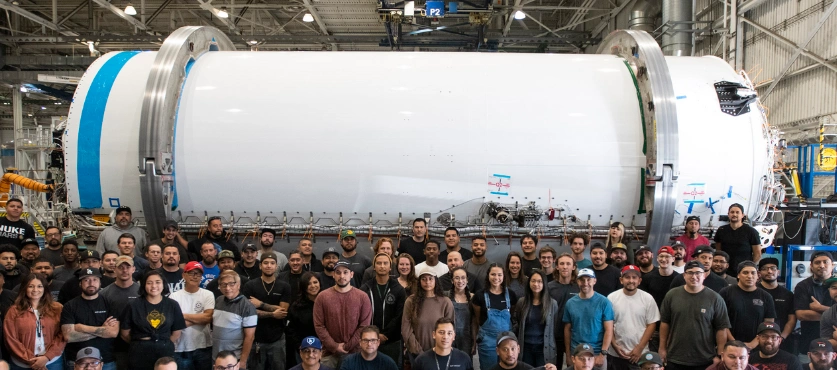
Things are getting crowded up there, even beyond low-Earth orbit: On August 5th, a discarded SpaceX Falcon 9 upper stage is expected to strike the Moon. Bill Gray at Project Pluto announced the imminent impact and maintains an extensive page on the event.
The booster was part of SpaceX’s January 15, 2025, launch, the one that sent Firefly Aerospace’s Blue Ghost and iSpace’s Hakuto-R2 landers to the Moon. Blue Ghost successfully landed on March 2, 2025, and carried out two weeks of surface operations, including the capture of the first solar eclipse from the lunar surface. Hakuto-R2’s Resilience lander fell silent before “litho-braking,” landing hard on the Moon on June 5, 2025.
“This object has spent almost all of its time at distances similar to that of the Moon,” says Bill Gray (Project Pluto) in his post on the object and the event. “Generally speaking, such objects are very poorly tracked.” He notes that the U.S. military mostly tracks objects using radar, which tracks low-orbiting junk pretty well. But radar can’t track objects near the Moon so easily. Out there, 400 times farther away than low-Earth orbit, radar signals are about 256 million times fainter. (The booster does have some tracking, though, and is given the ID 2025-010D or NORAD 62719.)
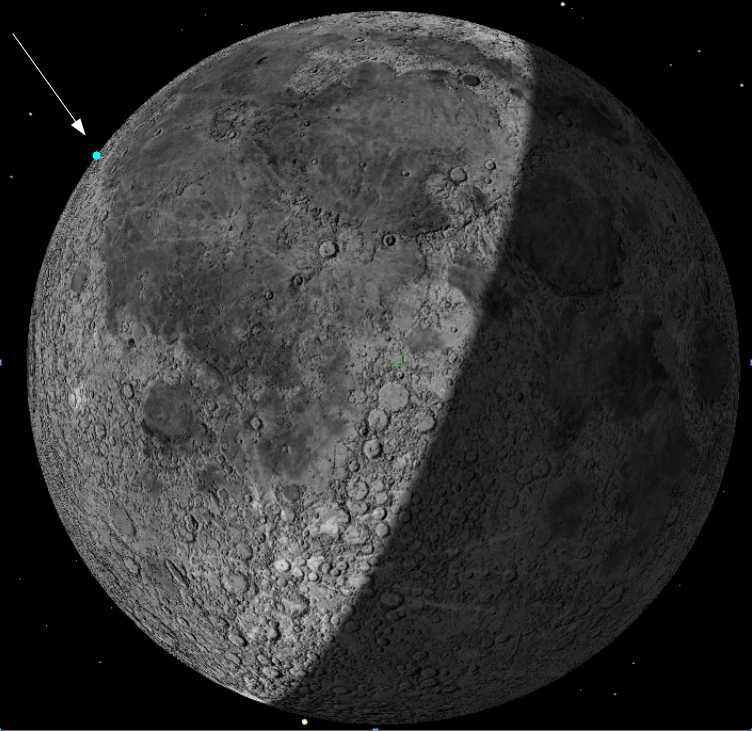
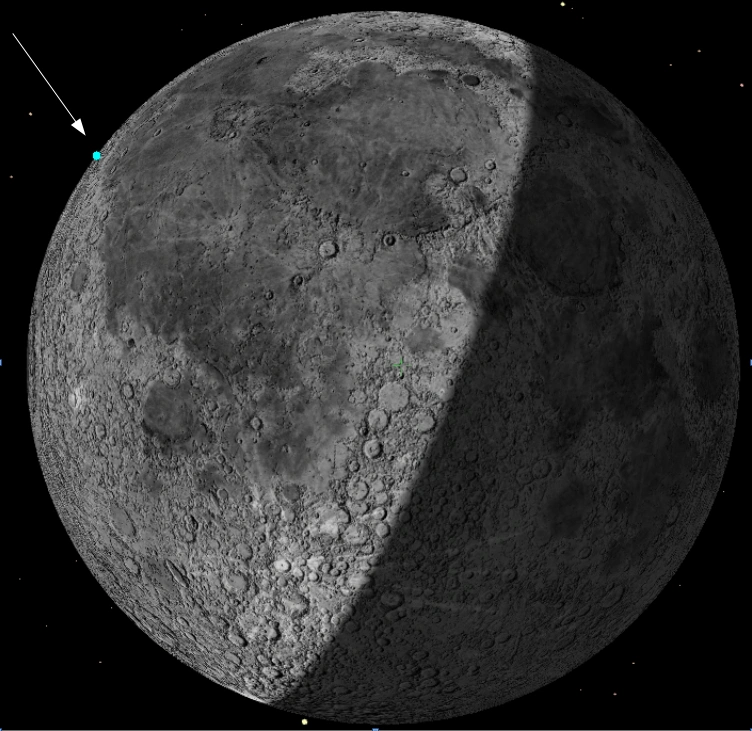
Measuring 13.8 meters (45 feet) long and 3.7 meters in diameter, the booster is roughly the size of a semi-trailer truck. Gray predicts it will impact the Moon at 2:44 a.m. EDT (6:44 UT), at a time when the Moon is in the waning gibbous phase, 58% illuminated. The Moon will be above the horizon in the early morning skies for the Americas.
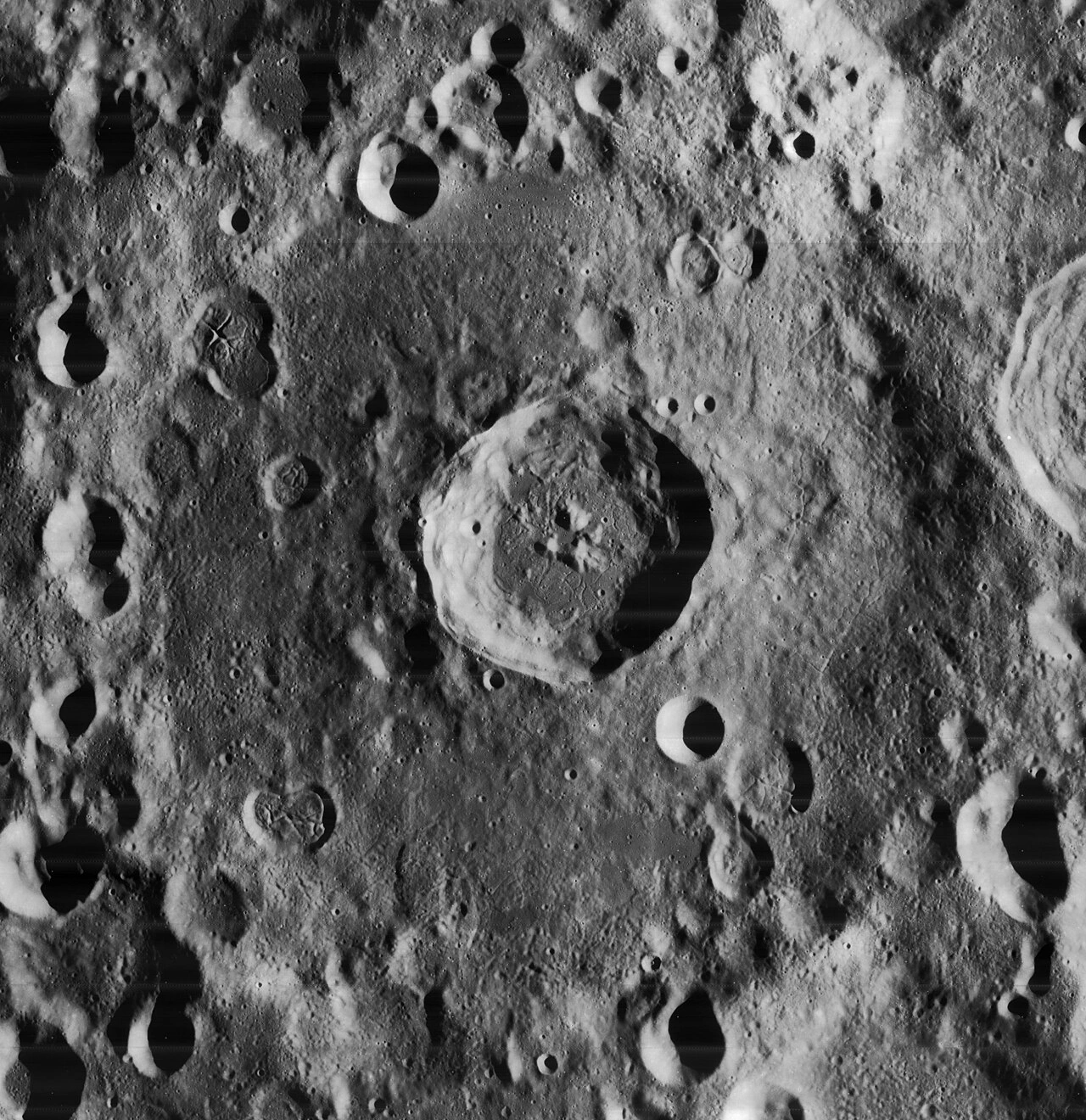
Unfortunately, visibility prospects aren’t good. The impact is expected to occur on the illuminated side of the Moon near Einstein Crater. This crater is near the lunar limb and only occasionally visible from Earth due to the Moon’s wobble, or libration.
Bill Gray / Project Pluto
NASA
Lunar Impacts Since 1959
The first human-made object to strike the Moon was the Soviet Union’s Luna 2 in 1959. Most of NASA’s Apollo-era hardware eventually struck the Moon as well, with impacts recorded by seismology experiments left on the lunar surface.
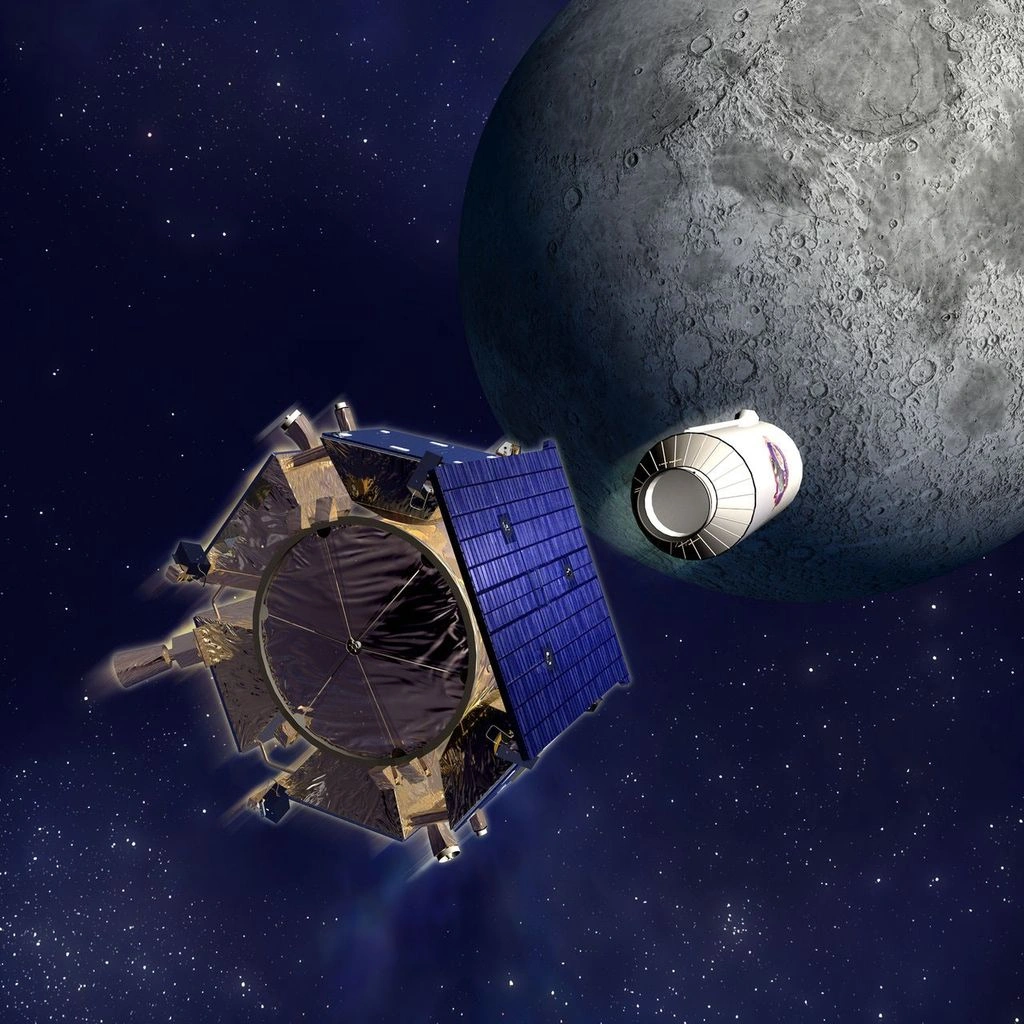
In 2009, NASA’s Lunar Crater Observation and Sensing Satellite (LCROSS) deliberately struck the Moon near Cabeus Crater, in an effort to search for water in the resulting debris plume. Amateur astronomers tried but weren’t able to see this event.
NASA
Another similar event occurred in 2022, when an object approached the Moon for impact. Initially, it was suspected to be another Falcon 9 S2, but it turned out to be a Long March 3C booster from China’s Chang’e 5 T1 lunar mission. NASA’s Lunar Reconnaissance Orbiter (LRO) imaged the resulting crater, and will likely document this August’s impact as well.
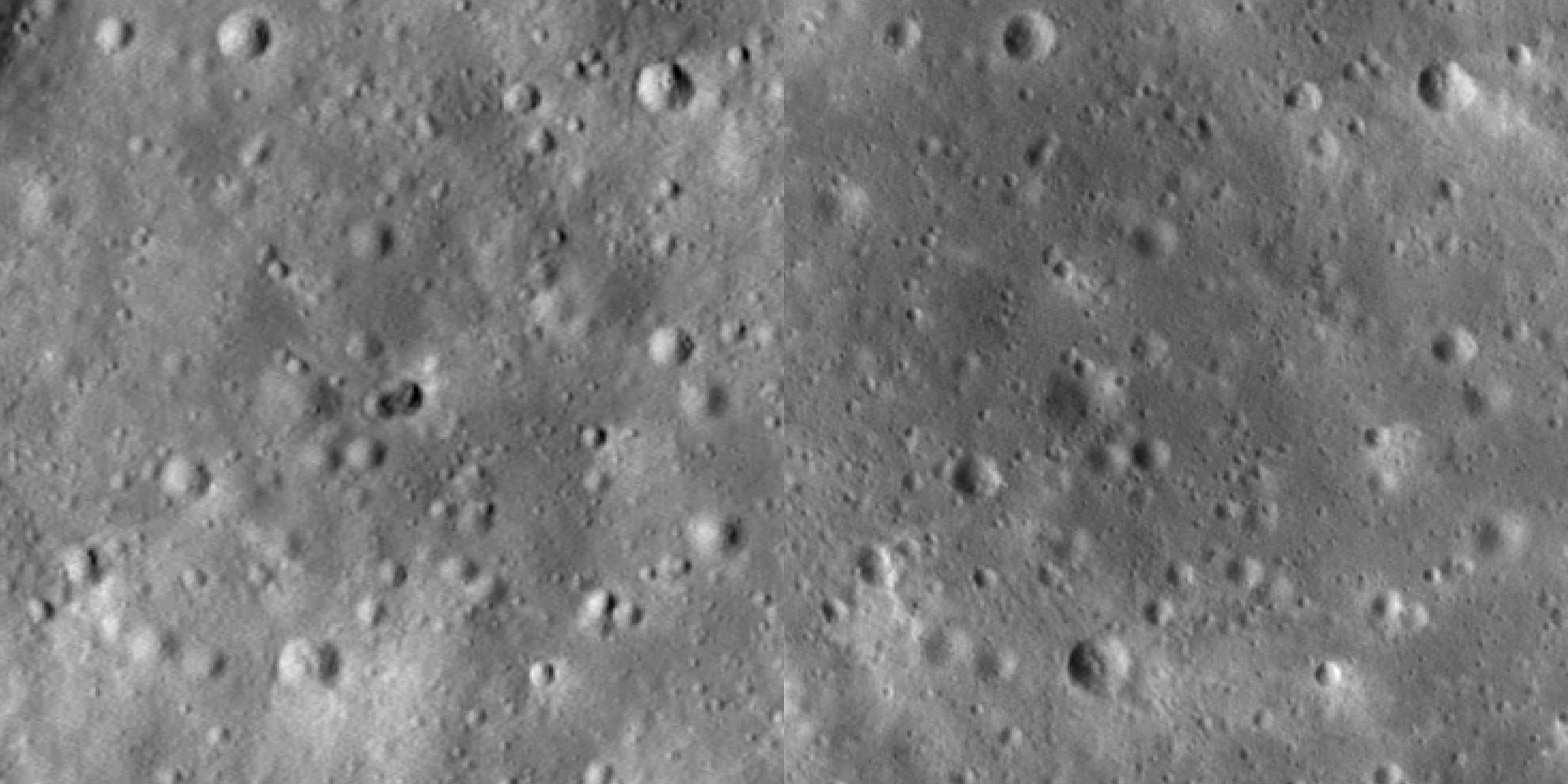
NASA/LRO
Though the impact poses no danger, it highlights the growing issue of debris in the space around the Moon. Though the amount of satellites and space junk in low-Earth orbit is growing exponentially, it’s at least tracked by NORAD, ESA, and other agencies. The same cannot be said for objects in high-Earth orbit and beyond.
“Cis-lunar space debris is difficult to track,” agrees Marco Langbroek (Delft University of Technology, The Netherlands). “There currently is no dedicated tracking network for these objects: All tracking data comes from chance detections by near-Earth asteroid surveys.” Even then, detected objects are often lost. When some are“rediscovered” in near-Earth asteroid surveys, it takes time to figure out they are actually returning space junk. Effects such as solar radiation pressure compound the tracking problem.
“This is not easy to model,” Langbroek says. “We are currently working on improving orbital integration models and our grip on all the orbit-disturbing effects at play in order to increase our abilities to predict the evolution of such cis-lunar orbits into the future.”
The Moon and the space around it is becoming busier, as NASA, China, and the European Space Agencies along with related commercial interests head to the Moon. While no humans are on the Moon now, the aim is to put them there, as well as scientific equipment. Since the Moon has no protective atmosphere, even small, high-velocity pieces of space debris could pose a hazard.
“These impacts are also a potential threat to heritage sites on the Moon, for example, the Apollo 11 landing site and other sites of great historic significance on the Moon,” says Langbroek. “Imagine losing Neil Armstrong’s first footprints on the Moon: That would be a true historic loss.”
ESA’s Space Debris Office proposed a solution back in 2015: Boosters should enter orbit around the Sun once their associated lunar missions are complete. This is probably a worthy solution, at least until we fill up the inner solar system as well. (Remember the Tesla Roadster SpaceX put out in orbit around the Sun in 2018?)
It’s a strange new sky, watching all the new, artificial stars that populate dawn and dusk. The same may soon be true for the Moon, as we grapple with the growing issue of space debris.