See the Moon Hide Regulus, the Stellar Heart of the Lion
Bob King
Only four 1st-magnitude stars lie along the Moon’s weaving path: Regulus, Spica, Antares, and Aldebaran. Each has its own occultation season, when the Moon briefly occults the star at successive lunations for up to several years. Many of these coverups occur at off times, when the Moon lies below the horizon from a particular observing location. Clouds are also a factor. But if you’re patient, your time will come to experience the thrill of watching a bright star vanish behind the lunar limb.
Occult 4.0
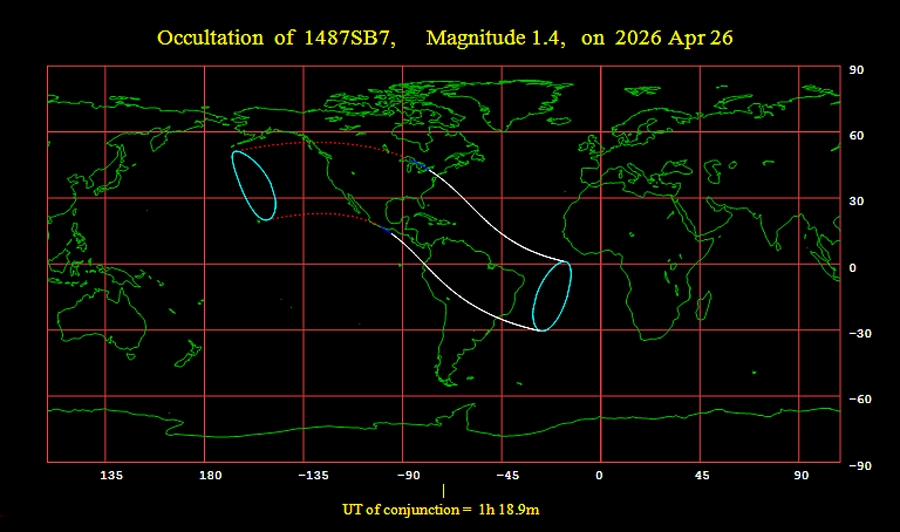
For some of us, that time arrives on Saturday, April 25-26, when observers in the eastern U.S., Central America, and a sizable chunk of northeastern South America will see the 71% waxing gibbous Moon occult Leo’s brightest star, Regulus. The disappearing act occurs in early- to mid-twilight for the Eastern Time Zone and at or shortly before sunset for the Midwest. Farther west, it happens in broad daylight.
IOTA India
The Moon travels eastward in its orbit, so its dark limb will bear down on Regulus before covering it. Prior to occultation, the target star seems to hover “forever” just beyond the limb like a hypothetical spaceship taking an infinite amount of time to cross the event horizon of a black hole — as seen by an outside observer. But suddenly the star is gone, swallowed by the Moon’s black edge. It happens so fast you’ll wonder if you even saw it.
Such will be Regulus’s fate that Saturday night. No finer demonstration of the absence of a significant lunar atmosphere exists than watching an occultation. Were there air on the Moon, Regulus would gradually fade and disappear.
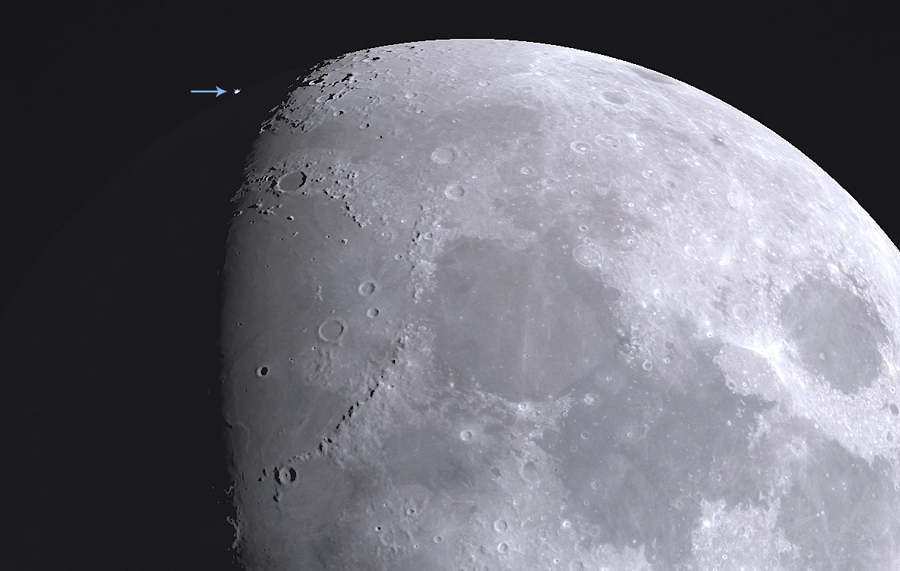
Stellarium
Depending on your location, Regulus will remain hidden anywhere from seconds to more than an hour. Observers located at the edge of the viewing zone will witness a grazing occultation. From Princeton, New Jersey, for instance, the star will scrape the edge of the darkened north polar region for about 8 minutes before exiting. Farther south in Miami, it passes more centrally behind the Moon and remains out of view for 1 hour, 24 minutes. Occultations are always double events (disappearance followed by reappearance), so you get two chances to observe the star both going in and coming out.
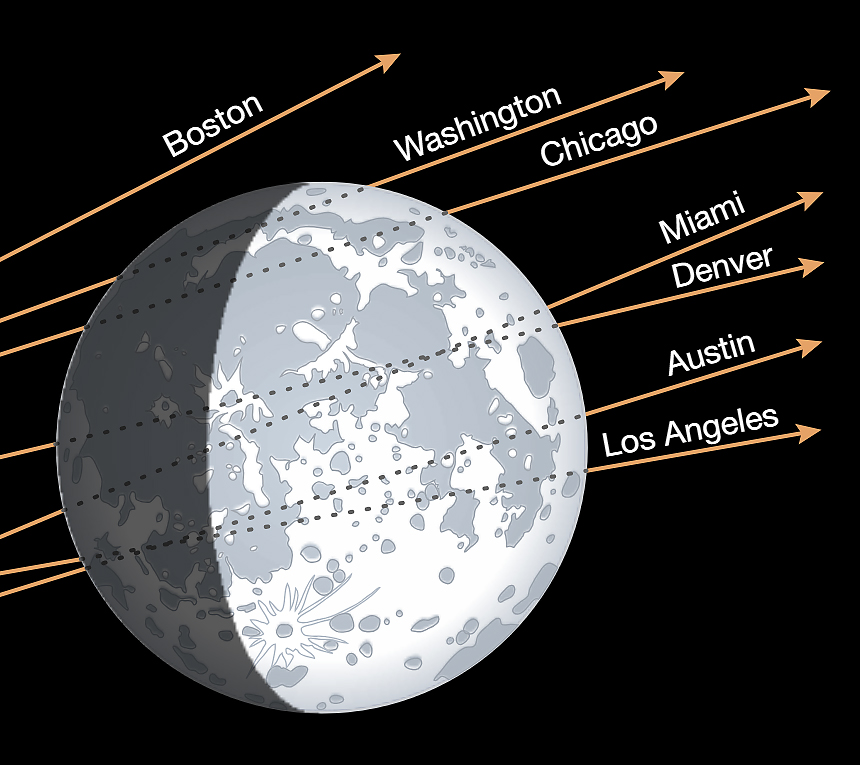
Sky & Telescope illustration
Regulus is well-placed for viewing across the U.S. but only along the Eastern Seaboard will the sky be dark enough to spot it with the unaided eye prior to disappearance. When the star reappears at the bright limb, night will be underway, but glare will prevent viewing Regulus without optical aid for at least 15 minutes. Farther west, the sky will be too bright to see the star without a telescope or binoculars.
A telescope is really the way to go when observing a lunar occultation. The extra aperture and magnification defeat glare, ensuring you’ll see Regulus the moment it disappears and reappears. Since I also like to photograph occultations, I use two telescopes — a small, motor-driven refractor for photography and a reflector for visual observing. I set the scopes a short distance apart and watch through the reflector while holding the camera’s shutter remote release. At the crucial moments I click away, so my eye never leaves the eyepiece.
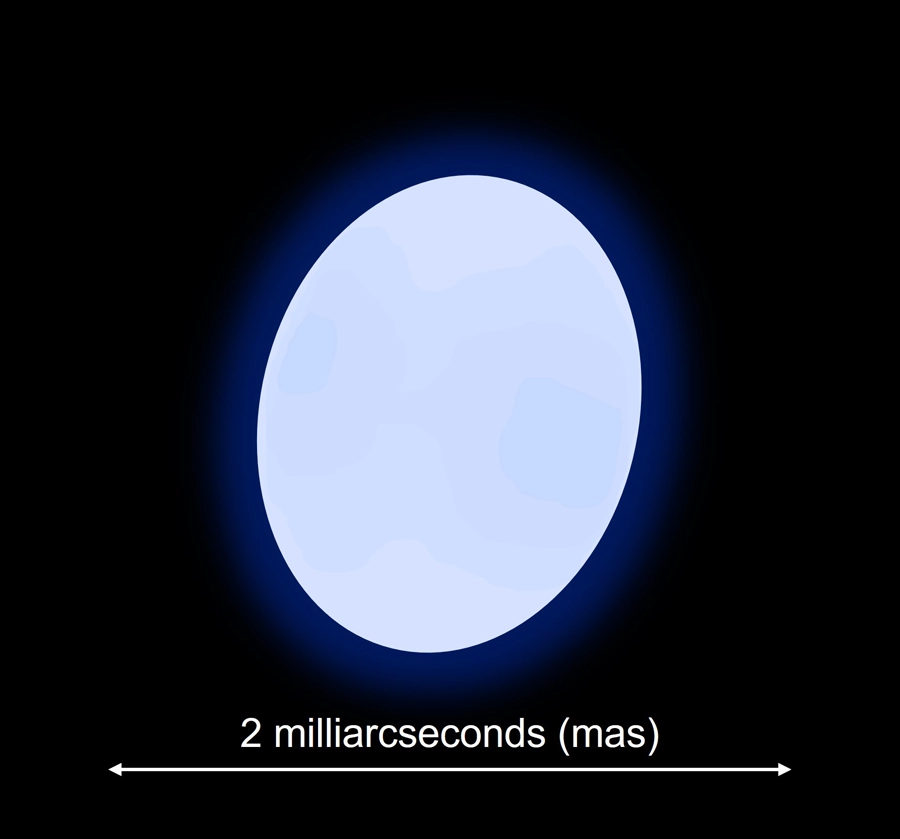
Stanley Joseph, based on interferometric imaging
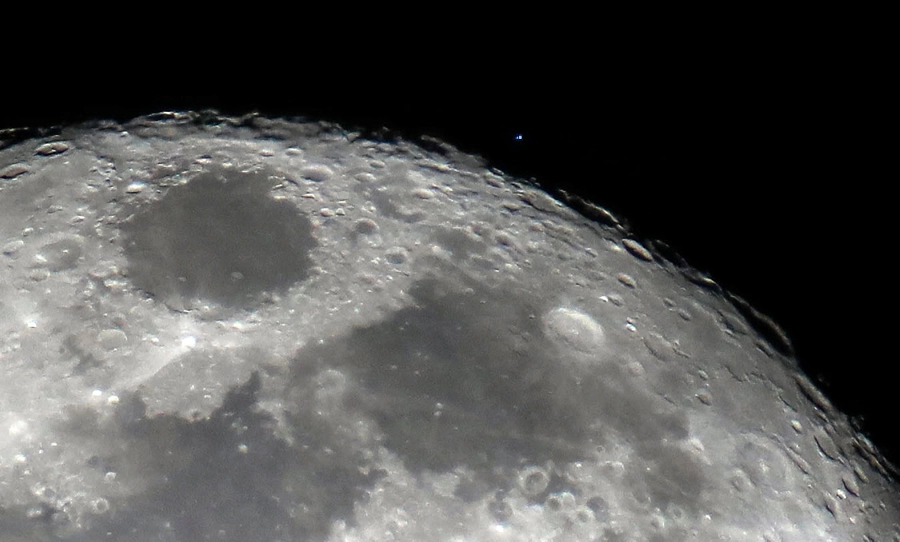
During February’s occultation of Regulus I was struck by how blue the star looked when it popped back into view. Although its spectral classification shows it to be a hot, blue-white sun, I don’t recall ever seeing the color so intensely. Perhaps it was a color contrast effect caused by the star’s proximity to the monochrome lunar landscape.
If you live where the occultation occurs in daylight, don’t be put off. I once assumed I wouldn’t see an Aldebaran occultation because the Sun was up. Yet there it was, a ruddy sparkle of light emerging from behind the Moon into a blue sky. Give a look, and you might surprise yourself. If you see the occultation in broad daylight, please drop me a note in the Comments section below.
Regulus’s occultation season repeats about every 8 to 9 years. The current cycle began in July 2025 and wraps up in December this year. The next time the Moon covers the star for U.S. observers will be on June 27, 2036. That fact should provide all the motivation you need to not miss the April show.