Astronomers reveal how molecular clouds survive in harsh outskirts of the galaxy

The outskirts of the Milky Way offer a unique laboratory to study molecular clouds and star formation under metal-poor conditions. Unlike the inner galaxy, including the solar neighborhood, the molecular gas in this region experiences low density, reduced metallicity, and minimal influence from spiral arm perturbations.
These factors result in a simpler star formation history. However, due to their distance, diffuse nature, and weak star formation activity, molecular clouds at the galactic edge have been poorly observed, leaving their physical properties and star formation mechanisms largely unexplored.
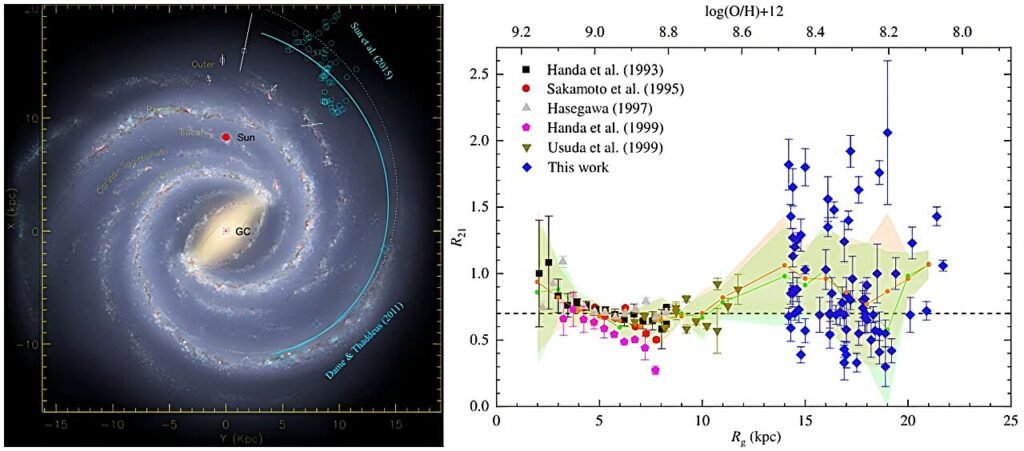
A research team from the Xinjiang Astronomical Observatory (XAO) of the Chinese Academy of Sciences used the IRAM 30-meter telescope in Spain to observe a large number of molecular clouds at the galactic edge with a galactocentric distance of 14–22 kiloparsecs.
In conjunction with the CO (1–0) data from the “Milky Way Imaging Scroll Painting” project of the Purple Mountain Observatory, the researchers systematically analyzed the variation of the CO (2–1)/(1–0) line ratio (R21) in the molecular clouds at the edge of the Milky Way.
Their findings, published in Astronomy and Astrophysics, reveal that the average R21 value in the galactic edge is significantly higher than that in the inner galaxy and nearby molecular clouds, consistent with observations in metal-poor galaxies.
In addition, the R21 ratio in the galactic edge clouds shows a high degree of spatial dispersion.
Furthermore, statistical analysis indicates a significant spatial correlation between high R21 ratio gas and dense clumps as well as star formation activity.
This study elucidates the physical mechanism behind the elevated R21 ratio in metal-poor environments, providing important observational results for the study of molecular cloud evolution and star formation in extreme environments.
More information:
C. S. Luo et al, Molecular clouds at the edge of the Galaxy, Astronomy & Astrophysics (2025). DOI: 10.1051/0004-6361/202453007
Provided by
Chinese Academy of Sciences
Citation:
Astronomers reveal how molecular clouds survive in harsh outskirts of the galaxy (2025, August 7)
retrieved 7 August 2025
from https://phys.org/news/2025-08-astronomers-reveal-molecular-clouds-survive.html
This document is subject to copyright. Apart from any fair dealing for the purpose of private study or research, no
part may be reproduced without the written permission. The content is provided for information purposes only.