Voyager 1 Shuts Down Another Instrument
NASA
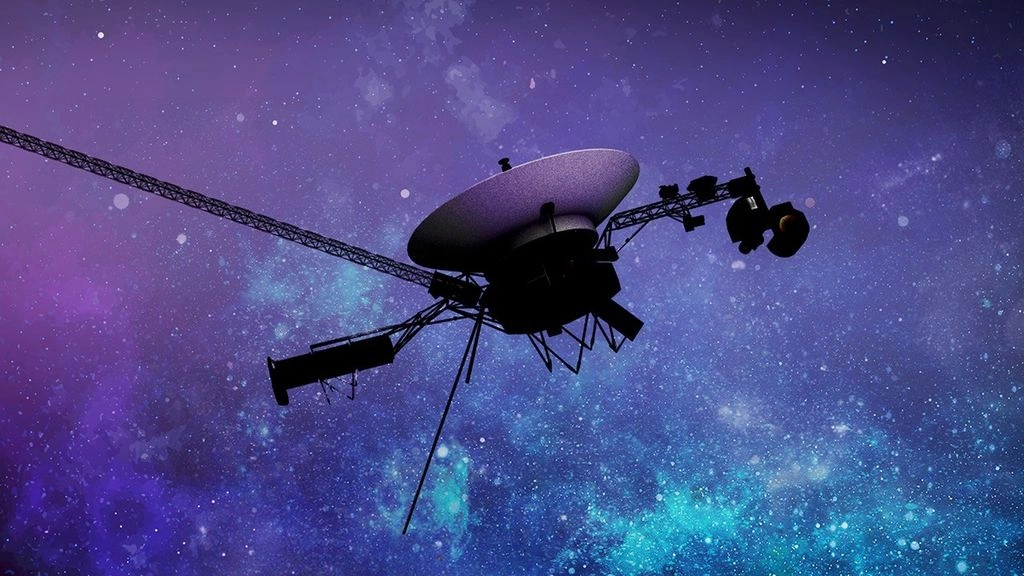
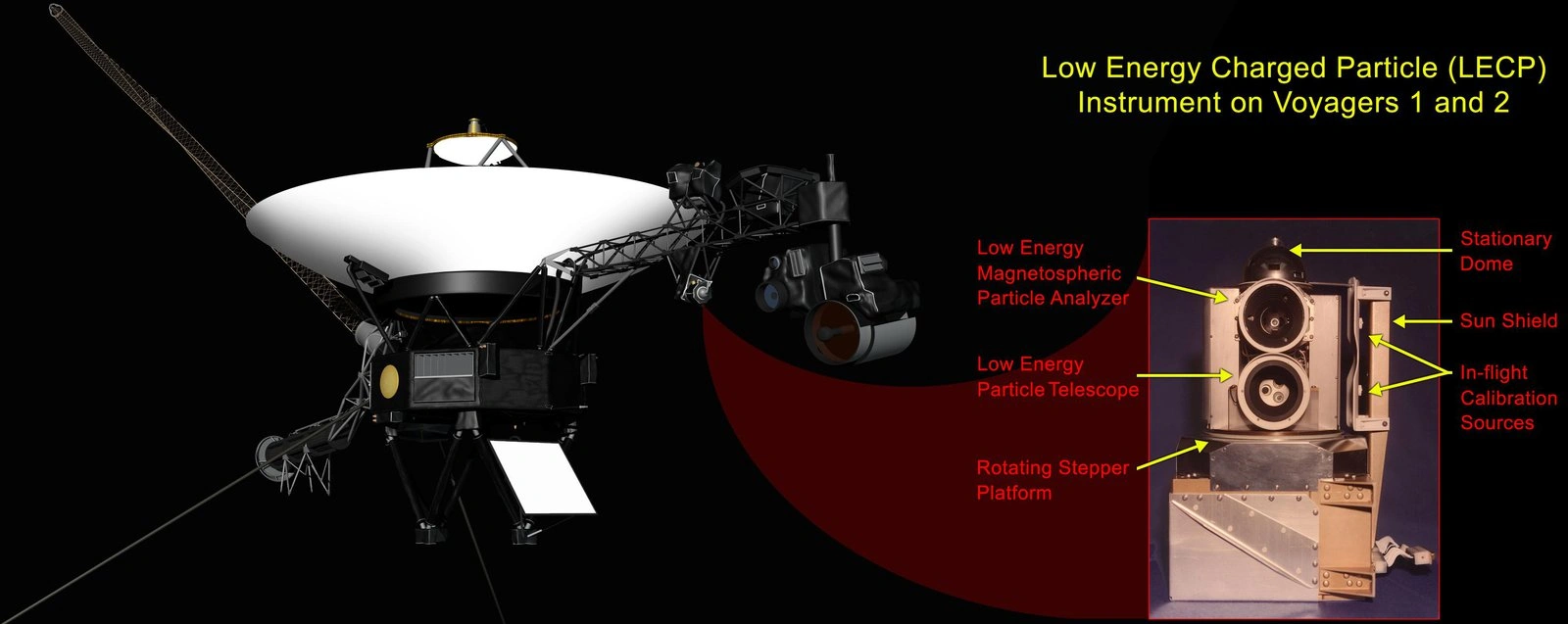
Voyager 1, one of NASA’s longest continuously running interplanetary missions, had another instrument turned off last week, in an effort to keep the spacecraft operational. On April 17th, controllers turned off the Low-Energy Charged Particles experiment (LECP), which had been operating nearly continuously for almost 49 years.
The LECP records charged particles in the interstellar medium, including both those coming from the Sun and from the wider galaxy. It was vital to measuring particle density in the region beyond our heliosphere, detecting pressure fronts and regions of varying density. The same instrument on Voyager 2 was already turned off in 2025.
NASA-JPL / Caltech
Turning off Voyager 1’s LECP reserves power for the rest of the spacecraft and its remaining instruments. The decision came after a routine roll maneuver on February 27th saw a power level drop. It nearly tripped the spacecraft’s under-voltage fault protection system, meant to shut down the probe and keep it in a safe mode status.
“While shutting down a science instrument is not anybody’s preference, it is the best option available,” says Kareem Badaruddin (NASA-JPL) said in a recent press release. “Voyager 1 still has two remaining operating science instruments. They are still working great, sending back data from a region of space no other human-made spacecraft has ever explored.”
The remaining instruments are the Magnetometer (MAG), which detects the magnetic fields that suffuse interstellar space, and the Plasma Wave Subsystem (PWS) instrument, which detects interactions between those magnetic fields and charged particles.
When the Voyager missions launched in 1977, they took advantage of a rare planetary alignment allowing for the two spacecraft to complete flyby missions of gas giants Jupiter and Saturn, with additional flybys (the only ones to date) of the ice giants Uranus and Neptune. Engineers opted to send Voyager 1 for a close flyby past Saturn’s enigmatic moon Titan, a maneuver that sent the spacecraft out of the plane of the solar system in 1980. Voyager 2 went on to Uranus in 1985 and Neptune in 1989.
It’s amazing to think that Voyager 1 has actually survived almost 10 times longer than its five-year nominal mission. Ironically, the mission was off to a rocky start — Voyager 1 was almost lost shortly after launch, when the second stage shut down prematurely and nearly stranded the mission in an incorrect orbit. But the Centaur stage compensated with a longer burn, and Voyager 1 was on its way.
Voyager 1 is currently the most distant spacecraft, at more 170 astronomical units (au) from Earth, in the direction of the Ophiuchus constellation. This November, it will be 1 light-day away. Voyager 2 is nearly 143 au away in the constellation Pavo. Voyager 1 crossed the heliopause boundary that separates our solar system from interstellar space on August 25, 2012; Voyager 2 followed suit in 2018.
Other missions escaping the solar system include the now defunct Pioneers 10 and 11, and the still operational New Horizons mission. NASA’s proposed Interstellar Probe (ISP) would see a slingshot mission out of the solar system, departing sometime in the mid-2030s.
The Voyager missions are fueled by a nuclear Plutonium-238 power source. Plutonium-238 has a half life of 87.7 years, and it’s necessary to power missions far from the Sun. Over the past decade, NASA has begun restarting its plutonium manufacturing pipeline for space missions. But despite the longevity and independence of this power source, it doesn’t last forever; the radioisotope thermoelectric generators (RTGs) are losing 4 watts of available power a year
The slow process of switching off Voyager 1’s 10 instruments started back in 1980, when the Photopolarimeter system was turned off due to degraded performance. The Plasma Science instrument was turned off in 2007 due to degraded performance, too. But the vast majority of the instruments functioned well until they were turned off to reserve power. Eight instruments have now been turned off. (See the timeline of both Voyagers’ instruments here.)

NASA / JPL-Caltech
The LECP shutdown gives Voyager 1 at least one more year of operations, the team estimates. But the instrument might not stay off. The Voyager 1 LECP has a small 0.5-watt motor that will remain on, and that could allow the instrument to power up again at a later date.
That date might come sooner than later. The Voyager team has an ambitious strategy in the works to keep both missions running and collecting even more data. Dubbed the “Big Bang,” the strategy would rotate out different instrument groups in an effort to collect data, conserve power, and keep the spacecraft warm. The team will test the Big Bang on Voyager 2 first, and then on both spacecraft between May and July.
NASA / JPL-Caltech
Hopefully, the Voyagers make it until their 50th anniversary next year. They’ve both provided an amazing bang for the buck, as the missions continue to give us a glimpse of the realm beyond our solar system.