
Operation Mahadev: How Satellite Phone Signal Led Security Forces to Pahalgam Massacre Mastermind
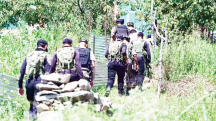

LIDWAS (Srinagar), July 29: In a major breakthrough against terrorism in Jammu and Kashmir, the Indian Army launched a precision strike, Operation Mahadev, leading to the elimination of three terrorists believed to be behind the recent Pahalgam attack. The operation was triggered after security forces intercepted a rare satellite phone signal from deep inside the Dachigam forests—an unusual event in the Valley that immediately alerted counter-terrorism agencies.
The signal was traced to Asif alias Sulaiman Shah, a key Lashkar-e-Taiba (LeT) figure suspected to be the mastermind of the Pahalgam attack. Asif had reportedly moved from the Pir Panjal range into the Kashmir Valley in 2024 and had remained under the radar until now. Intelligence and ground units acted swiftly, deploying multiple Army teams to search and dominate the suspected region.
Local nomads provided crucial inputs, helping narrow down the militants’ location in the Lidwas area. The Chinar Corps, along with 24 Rashtriya Rifles, 4 PARA, Jammu and Kashmir Police, and the CRPF, carried out a coordinated two-day search operation. On Monday, at approximately 11:30 AM, contact was established with a group of terrorists hiding in a makeshift trench under dense forest cover.
By 12:37 PM, drone footage confirmed the elimination of three terrorists, neutralised in a swift tactical assault. Among them was Junaid Ahmed Bhat, a local LeT operative linked to the Ganderbal tunnel attack of December. The identities of the remaining two are being ascertained, though sources initially confirmed one to be Asif. However, subsequent inputs suggest that Asif may have escaped and is still at large.
The slain militants are believed to be part of a joint LeT–Jaish-e-Mohammed module, which had been under surveillance for the last 14 days. The larger group is suspected to comprise 5–7 operatives, and search operations are ongoing to track down the remaining members, who are thought to be dispersed in the forested stretches of the region.
The use of a satellite phone—a rare and easily traceable device—played a crucial role in exposing the terrorist hideout and triggering the high-stakes operation. Intelligence suggests Asif may now attempt to flee the Valley or seek refuge in more remote terrain.
Security forces remain on high alert as the hunt for the Pahalgam attack mastermind intensifies.