Kargil Vijay Diwas: Prez Murmu, PM Modi lead nation in honouring fallen heroes
Drass commemorations led by Union Ministers, Army Chief
Northlines Correspondent
New Delhi/Drass, July 26 – On the solemn occasion of the 26th anniversary of Kargil Vijay Diwas, President Droupadi Murmu and Prime Minister Narendra Modi led the nation in paying heartfelt tributes to the brave soldiers who laid down their lives in the 1999 Kargil War, defeating Pakistan’s incursion in the rugged heights of Ladakh.
Observed every year on July 26, Kargil Vijay Diwas commemorates the culmination of Operation Vijay, when Indian armed forces successfully evicted Pakistani troops who had stealthily occupied strategic mountain outposts in the Kargil, Drass, and Batalik sectors. More than 500 Indian soldiers lost their lives during the nearly three-month-long conflict.
President Murmu, who is also the Supreme Commander of the Armed Forces, paid tribute to the indomitable courage of the jawans. “This day symbolises the extraordinary valour, courage and steadfast determination of our soldiers. Their dedication and supreme sacrifice for the nation will forever inspire its citizens,” she posted on social media.
Prime Minister Modi also saluted the armed forces, saying, “Kargil Vijay Diwas reminds the country of the unparalleled courage and valour of our soldiers who sacrificed their lives in defending the country’s pride.”
Defence Minister Rajnath Singh honoured the fallen heroes, stating, “Their supreme sacrifice during the Kargil war is a timeless reminder of the unwavering resolve of our armed forces. India shall remain forever indebted to their service.” He joined senior military leaders in paying homage at the National War Memorial in New Delhi.
Chief of Defence Staff General Anil Chauhan remarked that the day not only honours the past but also serves as a source of inspiration for future generations. “Our adversaries will continue to test our resolve, but the legacy of Kargil reminds us that jointness, preparedness, and courage will always triumph over deceit and aggression,” he said.
Drass Commemorations Led by Army Chief, Union Ministers
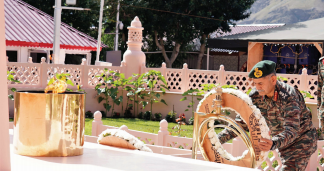
At the Kargil War Memorial in Drass, Army Chief General Upendra Dwivedi led the commemorations alongside Union Ministers Mansukh Mandaviya and Sanjay Seth, Ladakh Lieutenant Governor Brig (Retd) B D Mishra, and families of the martyrs.
General Dwivedi reflected on the enduring significance of the victory. “It was a time when India made it clear that no evil intention would be allowed within its borders. Continuing this tradition, during Operation Sindoor, our forces again displayed courage and resolve to neutralise Pakistan-backed terrorist infrastructure,” he said.
In a poignant moment, helicopters flew over the war memorial, showering petals on the cenotaphs. The Last Post was played, marking the culmination of the wreath-laying ceremony. Family members of the martyrs, veterans, and local residents gathered early in the morning to offer tributes.
Minister Mandaviya, who also holds the Youth Affairs and Sports portfolio, led a padyatra of hundreds of youth from across Ladakh. “We have always been victorious. Being victorious is our nature,” he said, urging the youth to adopt the spirit of ‘Nation First’ and build a stronger, developed India.
Minister of State for Defence Sanjay Seth addressed the gathering, praising the youth’s energy and recalling the courage and sacrifices of the soldiers. LAHDC Kargil Chairman Mohammad Jaffer Akhoon also participated in the march and the tribute ceremony.
A Day of National Pride and Remembrance
Across the country, the Indian Army, along with the Indian Air Force and Navy, organised various commemorative events. In Shimla, the Army Training Command (ARTRAC) hosted a public event with cultural programmes, school children’s performances, and exhibitions. The Indian Air Force celebrated the Rajat Jayanti (silver jubilee) of the Kargil victory from July 22 to 26 at Air Force Station Sarsawa, where Air Chief Marshal Rakesh Kumar Singh Bhadauria laid a wreath in honour of fallen air warriors.
The Kargil War, fought in one of the most inhospitable terrains and altitudes, remains a symbol of India’s military prowess, determination, and unity. It exposed Pakistan’s betrayal, as its army covertly infiltrated under the guise of mujahideen to seize control of key heights.
But India’s swift and determined counter-assault – marked by bravery, sacrifice, and exceptional tactical planning – turned the tide in its favour. On July 26, 1999, India reclaimed all occupied positions, prompting Pakistan’s retreat and securing a decisive victory.
Today, 26 years later, the nation salutes the 527 martyrs whose supreme sacrifice ensured India’s territorial integrity and reaffirmed its sovereignty.
Let Kargil Vijay Diwas not just be a ceremonial tribute, but a reminder of our collective duty to honour our soldiers, support their families, and uphold the ideals they laid their lives defending.
Op Sindoor strikes sent clear message to Pak: Army Chief
Drass (Kargil): Indian army chief General Upendra Dwivedi on Saturday said that the surgical strikes carried out during Operation Sindoor were a clear message to Pakistan that supporters of terrorism will not be spared.
“Operation Sindoor was a message to Pakistan as well as a response to the Pahalgam terror attack, which was a deep wound for the entire nation. This time India did not only mourn but showed that the response will be decisive,” Gen Dwivedi said at the Kargil War Memorial here.
Addressing a gathering on Vijay Diwas, the chief of army staff said a stern response to the adversary was the new normal established by India.
“The faith shown by the countrymen and the free hand given by the government, the Indian Army gave a befitting surgical response. Any power that tries to challenge the unity, integrity, and sovereignty of India or harm the people will be given a befitting reply. This is the new normal of India,” he said.
Gen Dwivedi said that during Operation Sindoor, the army eliminated nine high-value terrorist targets in Pakistan with zero collateral damage.
“India attained a decisive victory by effective targeting of terror infrastructure in Pakistan during Operation Sindoor. The army targeted the terrorist infrastructure and foiled the other aggressive moves of Pakistan to attain a decisive victory,” he said.
Dwivedi said Indian gave peace a chance, but Pakistan resorted to cowardice.