Dawn Comet C/2025 R3 (PanSTARRS) May Hold a Surprise

Dan Bartlett
While Comet PanSTARRS (C/2025 R3) may never achieve the hoped-for splendor of the sungrazer Comet MAPS, at least its future appears more certain. It passes perihelion at a relatively chill 74.6 million km (46.4 million miles) on April 19th, compared to a Sun-scorching 162,000 km (100,700 miles) for the MAPS comet. If they both pull through, we’ll double our money, with bright, naked-eye comets visible at both dusk and dawn. But if MAPS can’t take the heat, at least we’ll have a solid runner-up.
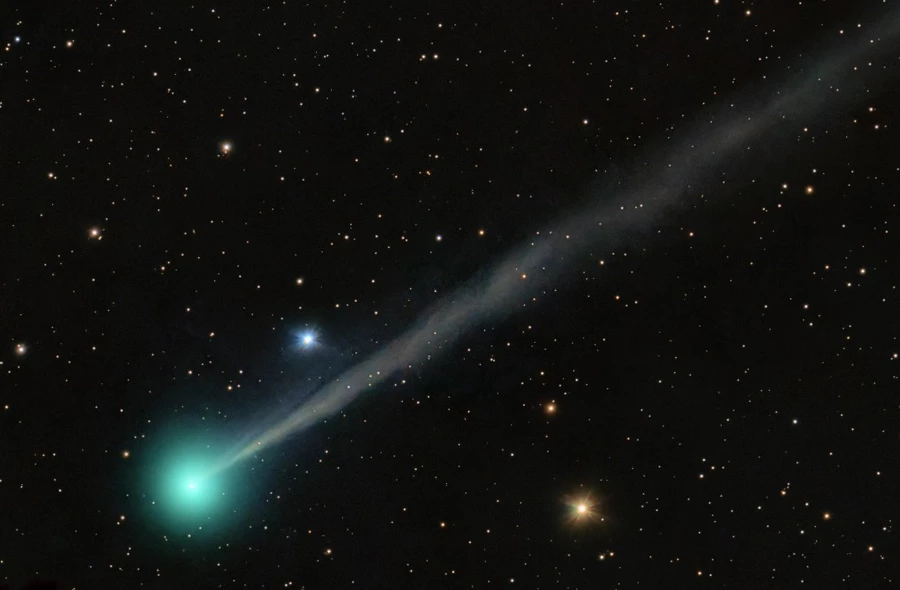
The Pan-STARRS 1.8-meter survey telescope in Hawai’i nabbed the comet on September 8, 2025, when it was around magnitude 20. Months later, it’s bloomed into a binocular object. In my 10×50s on March 23rd, Comet PanSTARRS was a small, round, 8.2-magnitude smudge located just west of the Great Square of Pegasus low in the eastern sky at the start of dawn. My 15-inch reflector at 76× revealed a bright, dense, aqua-colored coma about 3.5′ across. I even made out a skinny tail about ¼° long pointed northwest. Current photos extend the tail’s length to well over 1°. A very nice comet!
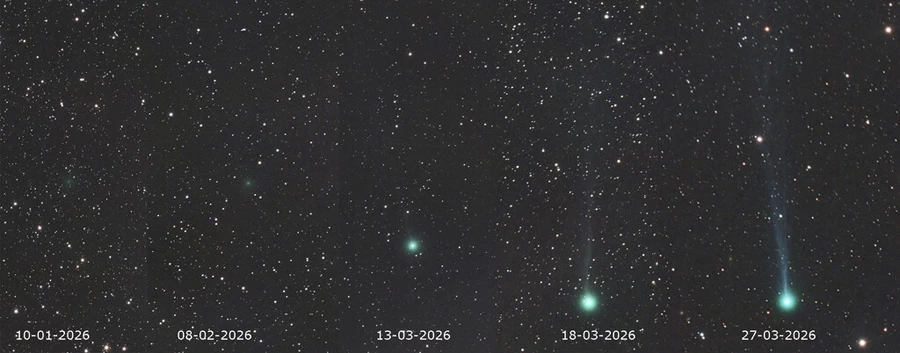
Didac Mesa Romeu
The viewing window was narrow — I only had 20 minutes of dark-sky time due to the comet’s low altitude of about 10° at the start of twilight. By April 1st it had brightened another full magnitude to 7. Spotting it in binoculars is now easy as long as you have a clear view to the east and carefully plan your viewing time to maximize the brief interval of darkness around the start of dawn. Early in the month, the object stands about a dozen degrees high at first light. Keep in mind that the Moon will interfere for the next few mornings until its phase diminishes to around half.
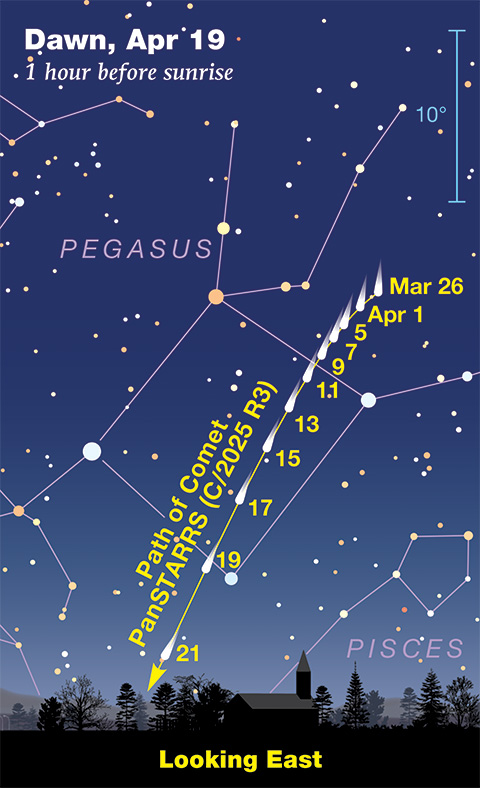
Sky & Telescope illustration
For the next two weeks, the Oort Cloud visitor will remain visible in a reasonably dark sky as it slices across the bottom of the Great Square. Although its altitude declines — slowly at first, then with increasing speed — it waxes brighter and brighter. About April 15th, when the comet hovers just a handful of degrees high in early twilight, it could reach 4th magnitude. Binoculars should reveal both the comet’s bright head and a wispy tail sticking upward to the west. Keen-eyed skywatchers with dark skies may even glimpse the cosmic Q-tip with the unaided eye.
And it could get brighter yet. Comet PanSTARRS will pass nearly between us and the Sun during its perihelion plunge. Backlit by the Sun, it could potentially brighten by several additional magnitudes. The phenomenon, called forward scattering, is the same reason a dirty windshield creates unwanted glare when driving toward the Sun. The crud flares so brightly, scattering light into your eyes and making the road hardly visible!
While a magnitude boost is possible, if that fails, C/2025 R3 is still worth your attention. Although low, it’s accessible, growing brighter, and visible from a wide swath of the planet across both hemispheres. And if you’re using a Dobsonian-style telescope, don’t forget to bring a kneepad!