Hidden in the sun’s glare, this asteroid is uncomfortably close to earth

In the distant past, the solar system was rife with impacts and collisions. Millions of rocky objects zoomed chaotically through the system, smashing into each other in collisional cascades. Over time, many of them eventually became part of the rocky planets. What’s left of the space rocks are mostly gathered in the main asteroid belt.
But some are otherwise hidden in difficult to observe locations. Unfortunately for life on Earth, some of the most difficult to spot ones are close to us. They’re hidden in the sun’s glare and are uncomfortably close to our earthly home.
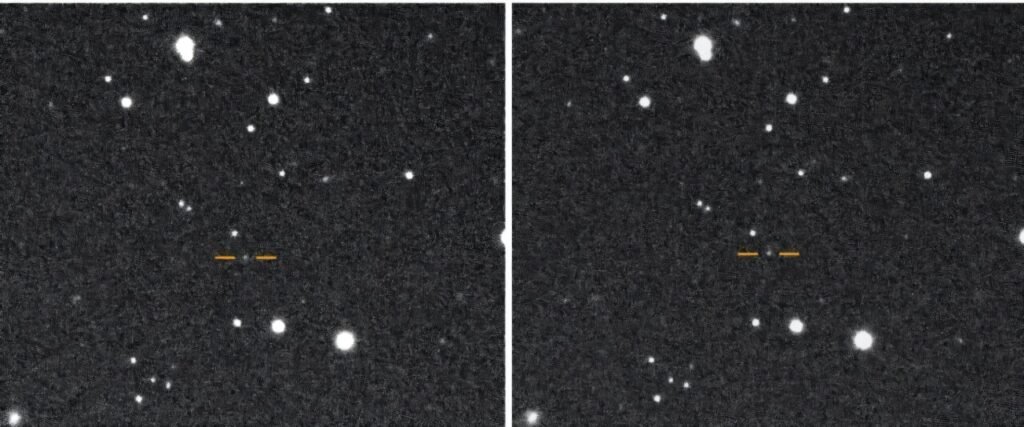
A scientist at the Carnegie Institute for Science has discovered a new asteroid in our neighborhood. Its name is 2025 SC79 and it’s the newest member of the Atira asteroid group. These are near-Earth asteroids with orbits entirely within Earth’s orbit. Atiras are the least numerous group of near-Earth objects and 2025 SC79 is the 39th member.
These objects are challenging to spot because their meager light is drowned out by the sun’s overpowering glare. This new space rock is only the second known object with an orbit entirely within Venus’ orbit. It also crosses Mercury’s orbit, and completes a trip around the sun in only 128 days. It has the third shortest orbital period of any asteroid, with the two fastest ones both having an orbital period of only 115 days. For comparison, Mercury’s orbital period is only 88 days.
Carnegie Science astronomer Scott S. Sheppard discovered the asteroid on September 27 with the Dark Energy Camera on the National Science Foundation’s Blanco 4-meter telescope. That telescope searches for killer asteroids, and 2025 SC79 certainly qualifies. 2025 SC79 is about 700 meters (2,300 ft) in diameter. While small compared to the Chicxulub impactor that ended the dinosaurs, that size asteroid would still create a catastrophic impact on a continental scale. Depending on where it landed, it could kill billions of people and animals.
The sighting was later confirmed with two other telescopes: the NSF’s Gemini telescope and Carnegie Science’s Magellan telescopes.
“The most dangerous asteroids are the most difficult to detect,” Sheppard explained in a press release. “Most asteroid research finds these objects in the dark of night, where they are easiest to spot. But asteroids that lurk near the sun can only be observed during twilight—when the sun is just about to rise or set. If these ‘twilight’ asteroids approach Earth, they could pose serious impact hazards.”
There’s a lot more to learn about 2025 SC79 but that will have to wait. It’s disappearing behind the sun for a few months. Once it reappears, astronomers will examine it for more detailed information. Its composition is an important question, since it’s surviving exposure to the sun’s intense heat. Further observations may also shed light on the asteroid’s origins. It may have been dislodged from the main asteroid belt somehow and then captured by the sun.
“Many of the solar system’s asteroids inhabit one of two belts of space rocks, but perturbations can send objects careening into closer orbits where they can be more challenging to spot,” Sheppard concluded. “Understanding how they arrived at these locations can help us protect our planet and also help us learn more about solar system history.”
Provided by
Universe Today
Citation:
Hidden in the sun’s glare, this asteroid is uncomfortably close to earth (2025, October 22)
retrieved 22 October 2025
from https://phys.org/news/2025-10-hidden-sun-glare-asteroid-uncomfortably.html
This document is subject to copyright. Apart from any fair dealing for the purpose of private study or research, no
part may be reproduced without the written permission. The content is provided for information purposes only.