Neural network method can automatically identify rare heartbeat stars

Researchers from the Yunnan Observatories of the Chinese Academy of Sciences (CAS) have unveiled a neural network-based automated method for identifying heartbeat stars—a rare type of binary star system. Their findings are published in The Astronomical Journal.
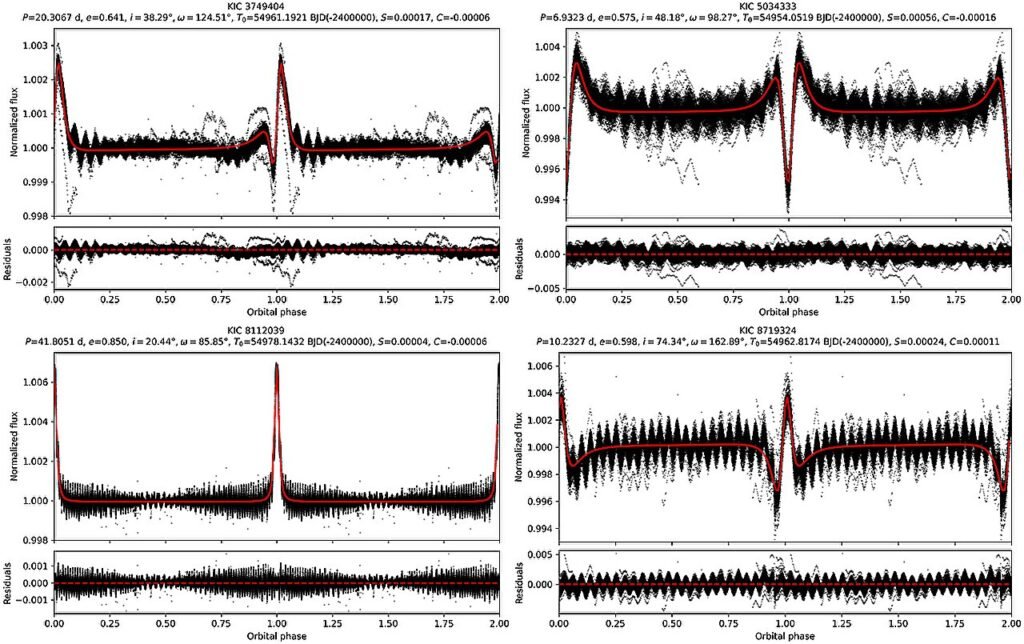
Heartbeat stars are eccentric-orbit binary systems distinguished by periodic brightening events, which create light curves similar to electrocardiograms. Many of these systems also exhibit tidally excited oscillations (TEOs), providing an opportunity to study cosmic phenomena such as tidal interactions, stellar internal structure, and binary evolution. However, the morphological diversity of their light curves makes manual identification challenging, especially in large-scale astronomical surveys.
To address this challenge, the researchers designed a novel approach: they used orbital harmonics extracted from Fourier spectra as input features to train a neural network classifier. Testing showed the tool achieved an 86% accuracy rate in identifying known heartbeat stars and remained effective even for systems with TEOs.
Using photometric data from Kepler Space Telescope, the team analyzed 153 confirmed heartbeat star systems and built the largest parameter database of Kepler-detected heartbeat stars to date. Their work yielded key discoveries, including 21 new heartbeat star systems with TEOs. The researchers also developed an automated tool to differentiate between harmonic and non-harmonic oscillations, and successfully identified the phase and oscillation mode for 14 TEO-containing samples—insights that reveal details about the stars’ internal structures through pulsation theory.
The research is expected to provide methodological support for future astronomical studies, including those using data from Transiting Exoplanet Survey Satellite (TESS), as well as the China Space Station Telescope (CSST), the researchers noted.
More information:
Min-Yu Li et al, Heartbeat Stars Recognition Based on Recurrent Neural Networks: Method and Validation, The Astronomical Journal (2025). DOI: 10.3847/1538-3881/aded86
Provided by
Chinese Academy of Sciences
Citation:
Neural network method can automatically identify rare heartbeat stars (2025, September 30)
retrieved 30 September 2025
from https://phys.org/news/2025-09-neural-network-method-automatically-rare.html
This document is subject to copyright. Apart from any fair dealing for the purpose of private study or research, no
part may be reproduced without the written permission. The content is provided for information purposes only.