Launching India’s Future in Space Innovation
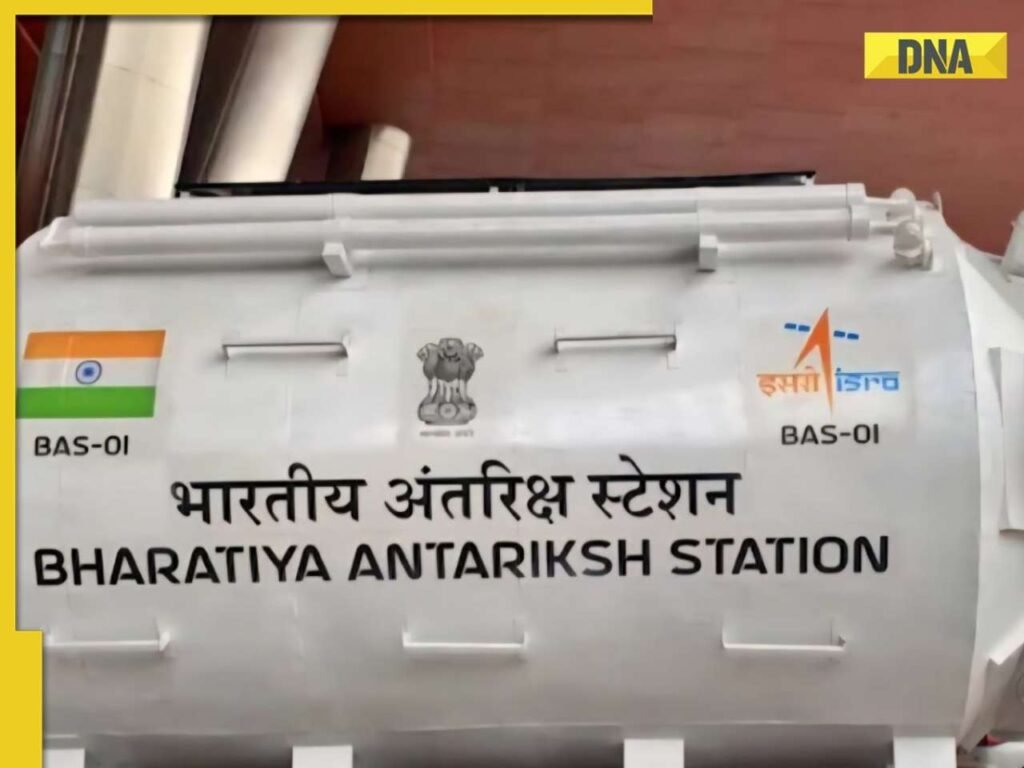
On Friday 22nd August 22nd August, ISRO unveiled a model of the Bharatiya Antariksh Station (BAS) module during the National Space Day celebrations. India plans to launch the first BAS module by 2028, joining the small group of nations that run their own space laboratories in orbit.
On Friday 22nd August 22nd August, ISRO unveiled a model of the Bharatiya Antariksh Station (BAS) module during the National Space Day celebrations.
India plans to launch the first BAS module by 2028, joining the small group of nations that run their own space laboratories in orbit.
At present, there are only two space laboratories in orbit — the International Space Station (ISS) run by five space agencies, and China’s Tiangong space station.
India plans to set up five modules of the Bharatiya Antariksh Station by 2035 as part of its ambitious space plans.
The BAS-01 module is planned to weigh 10 tonnes and will be placed in a low Earth orbit, 450 km above the Earth.

The Bharatiya Antariksh Station (BAS) will have many special features:
- Environmental Control and Life Support System (ECLSS): A system that provides oxygen, water, temperature control, and waste management to keep astronauts safe and healthy in space.
- Bharat Docking System: A mechanism for spacecraft to connect with the station, allowing astronauts, cargo, or equipment to move in and out.
- Bharat Berthing Mechanism: A system that helps slowly attach visiting spacecraft to the station in a secure way.
- Automated Hatch System: A door that opens and closes automatically, helping astronauts move safely between modules or spacecraft.
- Platform for Microgravity Research: An area where scientists can perform experiments in weightless conditions, useful for medicine, materials, and space science.
- Technology Demonstration: A place to test new space technologies before using them in bigger missions.
- Viewports for Scientific Imaging and Crew Recreation: Windows on the station for taking scientific pictures of Earth and space and also for astronauts to relax and enjoy the view.
The Bharatiya Antariksh Station (BAS) will also include several important systems:
- Refilling of Propulsion and ECLSS Fluids: Facilities to refuel engines and recharge life support systems like oxygen and water, so the station can keep working for many years.
- Radiation Protection: Shields to protect astronauts from harmful space radiation that can affect health.
- Thermal Protection: Systems to control heat and cold in space, keeping the station at a safe temperature.
- Micro Meteoroid Orbital Debris (MMOD) Protection: Layers of shielding to protect the station from tiny rocks and space debris that travel at very high speeds.
- Space Suits: Special suits that allow astronauts to work safely outside the station in the vacuum of space.
- Airlocks for Extra Vehicular Activity (EVA): Small chambers that let astronauts move in and out of the station during spacewalks without losing air.
- Plug and Play Integrated Avionics: Ready-to-use electronic systems that can be easily connected and replaced, making the station’s controls and computers more flexible and efficient.
The Bharatiya Antariksh Station (BAS) will act as a research platform to study space, life sciences, medicine, and interplanetary exploration.
It will allow scientists to study how microgravity affects human health and to test important technologies for long-term human stay in space.
The space station will also support space tourism, with India entering the commercial space sector using the orbital lab’s facilities.
The BAS will support international collaborations, act as a hub for scientific research, and inspire young generations to choose careers in space science and technology.
The huge 3.8m x 8m BAS-01 model was the main attraction at the National Space Day celebrations held at Bharat Mandapam.
(The author of this article is a Defence, Aerospace & Political Analyst based in Bengaluru. He is also Director of ADD Engineering Components, India, Pvt. Ltd, a subsidiary of ADD Engineering GmbH, Germany. You can reach him at: girishlinganna@gmail.com)
(Disclaimer: The views expressed above are the author’s own and do not reflect those of DNA)