
Decoding the two high level Summits aimed to end three and half year old Ukraine War
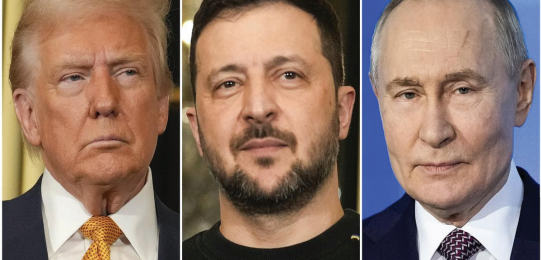
Trump has positioned himself as the key to any peace negotiations
By T N Ashok
WASHINGTON DC: The past six days have witnessed unprecedented diplomatic activity as President Donald Trump orchestrated two pivotal meetings aimed at ending the war in Ukraine. The August 15 Trump-Putin summit at Joint Base Elmendorf-Richardson in Anchorage, Alaska, followed by Monday’s White House meeting with Ukrainian President Volodymyr Zelenskyy and European leaders, represents a calculated diplomatic strategy that prioritizes direct engagement over traditional multilateral frameworks.
The Alaska summit ended without a concrete deal on the Ukraine ceasefire, yet this outcome may have been by design rather than diplomatic failure. With fighter jets, a red carpet and a hopeful slogan — “Pursuing Peace” — plastered on the wall, the optics were carefully choreographed to project strength while creating space for future negotiations.
The choice of Alaska as venue carries symbolic weight. Historically neutral ground between East and West, the location suggests Trump’s positioning of America as the indispensable mediator. The two leaders stood shaking hands as reporters shouted questions, asking Putin, for example, if he would support a possible ceasefire in Ukraine, but their silence spoke volumes about the preliminary nature of these discussions.
What emerged from Anchorage was not a breakthrough, but rather a framework for future engagement. Trump said that both Russian President Vladimir Putin and Ukrainian President Volodymyr Zelensky want him to attend a future potential meeting between the two leaders to discuss a path to peace. This positions Trump as the crucial third party without whose participation no sustainable agreement is possible.
The August 18 White House meeting represented a stark contrast in approach and outcomes. European leaders including France’s Macron, UK’s Starmer and EU’s von der Leyen joined Zelenskyy for a crucial Washington meeting with Trump, creating a united Western front that had been notably absent from the Alaska summit.
This gathering achieved several concrete objectives.. Trump’s meeting with Zelenskyy and European leaders concluded, Zelensky spokesperson Serhii Nikiforov told NBC News and other reporters via WhatsApp, indicating substantial progress requiring extended deliberation.
The meeting’s most significant achievement was establishing a pathway toward security guarantees for Ukraine. Trump-Zelenskyy meeting paves the way for Ukraine security guarantees, bilateral talks between Putin and Zelensky to be followed by trilateral including Trump.
Crucially, Trump took a break from his meeting with the European delegation on Monday to phone Putin and propose the direct meeting with Zelensky, and a potential trilateral meeting also involving Trump to follow later. This real-time diplomacy demonstrates how the European meeting served as leverage in communications with Moscow.
The two meetings produced several strategic achievements despite lacking formal agreements. First, Trump successfully positioned himself as the central figure in Ukraine peace negotiations, with both Putin and Zelenskyy accepting his mediation role. Second, the European leaders’ participation in Washington signals continued Western unity on Ukraine support, countering Russian expectations of fracturing Western resolve.
However, significant limitations remain apparent. Trump is ratcheting up pressure on Ukraine to agree to terms to end the war with Russia, echoing some of Moscow’s talking points two days after meeting President Vladimir Putin. This suggests that the Alaska summit may have influenced Trump’s negotiating position in ways that concern Ukraine’s supporters.
The sequencing of meetings also reveals strategic calculation. By meeting Putin first, Trump demonstrated willingness to engage with Moscow without European constraints. The subsequent European meeting then provided legitimacy and security guarantees that make any eventual agreement more credible to Ukraine.
President Trump says arrangements are underway for a meeting between Ukrainian President Volodymyr Zelenskyy and Russian President Vladimir Putin, with Trump’s participation as mediator. This trilateral approach represents the logical next step, combining the bilateral engagement established in Alaska with the multilateral legitimacy created in Washington.
The proposed framework faces substantial implementation challenges. Russia’s willingness to accept European security guarantees for Ukraine remains questionable, while Ukraine’s acceptance of territorial concessions – implied by Trump’s pressure tactics – remains politically difficult for Zelenskyy domestically.
European leaders’ participation provides both opportunity and constraint. Their involvement offers credible security guarantees and economic support for post-conflict Ukraine, but also limits Trump’s flexibility in negotiations. Any agreement must satisfy European concerns about precedent-setting for other territorial disputes.
The past week’s diplomacy demonstrates sophisticated strategic thinking despite apparent contradictions. The Alaska summit’s lack of concrete results created space for future negotiations without premature commitments. The White House meeting provided legitimacy and security frameworks essential for sustainable agreements.
Trump’s approach prioritizes process over immediate outcomes, recognizing that ending Europe’s largest conflict since World War II requires careful sequencing of bilateral and multilateral engagement. The proposed trilateral meeting represents the convergence of these separate diplomatic tracks into a unified negotiating framework.
Success will ultimately depend on whether this carefully constructed diplomatic architecture can bridge the fundamental gap between Russian territorial demands and Ukrainian sovereignty requirements. The European security guarantee framework provides one potential solution, but implementation will require sustained commitment from all parties well beyond any initial agreement.
The next phase of negotiations will test whether Trump’s bilateral engagement with Putin created genuine flexibility in Russian positions, or merely provided Moscow with additional leverage in multilateral settings. Similarly, European unity demonstrated in Washington must translate into concrete security commitments that make territorial compromises politically viable for Ukraine.
These two meetings have established the framework for potential peace negotiations, but the substance of any agreement remains to be determined through the challenging trilateral diplomacy that lies ahead. (IPA Service)