Inside Skyroot’s Max-Q Campus: Crafting India’s next rocket
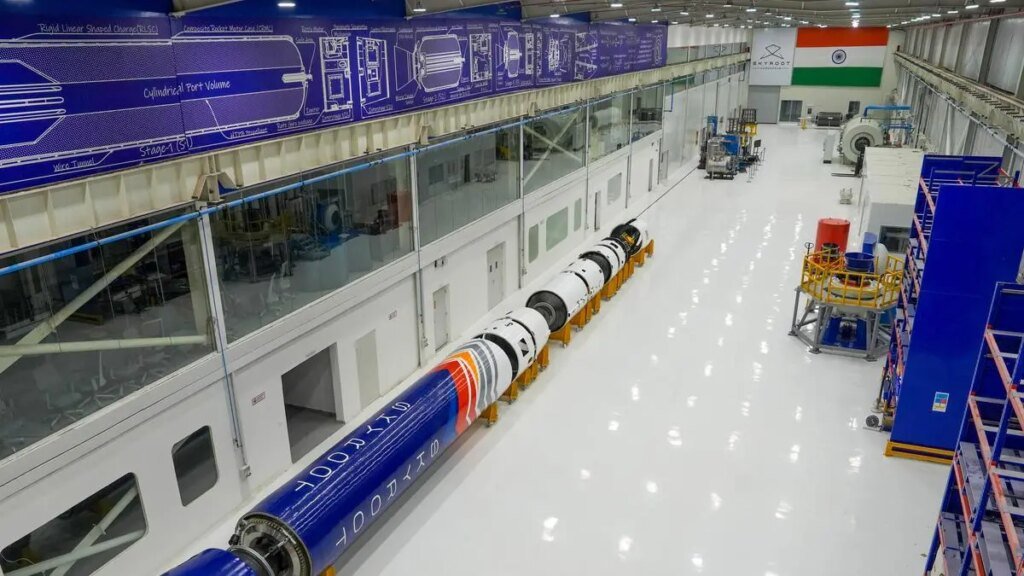

Skyroot Aerospace’s Max-Q Campus in Hyderabad.
At first glance, it can easily be mistaken for a sci-fi film set. As you walk through the giant Max-Q Campus of Skyroot Aerospace in Hyderabad, you can see teams of employees working on parts of a rocket, some on the nose cone, others on the frame, skin and fins. They are preparing the 22-metre odd Vikram-1 launch vehicle, slated for an orbital launch later this year.
The seven-storey, carbon-fibre Vikram-1 rocket, featuring 3D-printed engines, is meticulously crafted, pushing the boundaries of private space exploration and propelling the country onto the global launch stage.
This 3D printing approach drastically reduces complexity; what once required 150 parts can now be a single component, minimising failure points. Even smaller components, such as thrusters, which are crucial for changing the rocket’s direction in space, are also 3D printed.
Two weeks ago, it successfully completed static test-firing of the rocket’s Stage-1 carbon composite solid fuel booster stage at Sriharikota.

Armed with the data from the test, about 600 employees are now focused on fine-tuning various components, including the engine and the mission computer, which will act as the brain of the rocket as it takes several satellites into their respective orbits.
The static test validated the performance of the 30-tonne booster stage of the rocket, giving the team a fillip.
Anant, who is part of the core team involved in building the engine, was quite elated as news from Sriharikota emerged of the successful test firing. Ask this 30-year-old engineer if the ‘engine’ breaks into his dreams, and he would say “yes”.
Involved in the ‘motor’ building team from the beginning, he said the feedback from the static test was perfect. “A little bit of fine-tuning is required to make it more optimal”. He credited veterans from ISRO for helping him and his team in designing components at the system level.
A team of engineers and experts oversees the work from their mezzanine floor, which overlooks the manufacturing facility.
The entire Vikram-1 structure is made of carbon composites. Pawan Kumar Chandana, a Co-Founder, said that carbon is five times lighter than steel and five times stronger than aluminium.
The autonomous brain
Behind the Vikram rocket’s physical prowess lies its sophisticated autonomous brain – the mission computer. Spatika, a Kalpana Fellow who works on the embedded systems for this critical component, is part of the team that built this computer.
“It was a very proud moment. I felt great,” she said of the recent static test.
Explaining that the mission computer would work as the brain of the mission, she said it “takes all of the decisions” onboard.
The successful launch of the smaller Vikram S suborbital rocket in 2022—a six-metre-tall rocket—was a pivotal moment, demonstrating the technology’s effectiveness within just two years of the government’s policy announcement.
“We are prepared for a very long-term game. We aim to be among the very few players globally in the growing $30-billion launch market,” Pawan said.
Published on August 18, 2025