First asteroid sightings push Hera’s camera to the limit
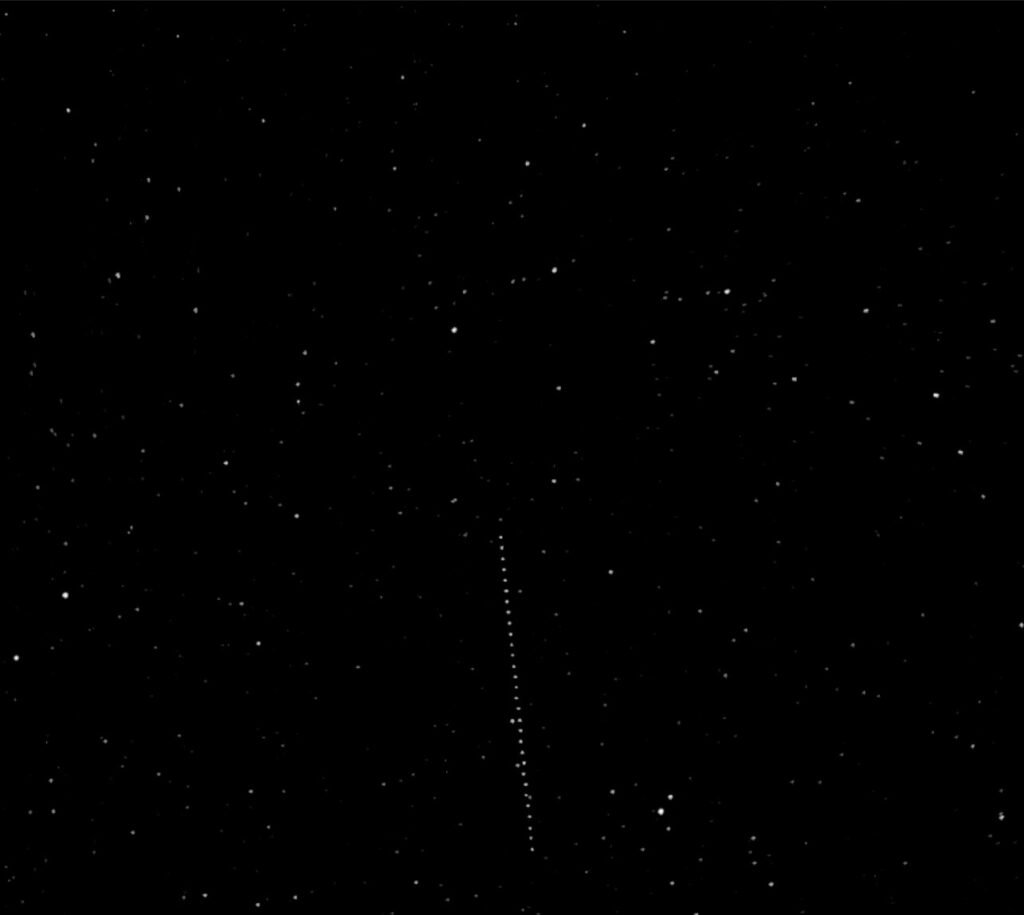

ESA’s Hera mission has captured images of asteroids (1126) Otero and (18805) Kellyday. Though distant and faint, the early observations serve as both a successful instrument test and a demonstration of agile spacecraft operations that could prove useful for planetary defense.
Hera is currently traveling through space on its way to a binary asteroid system. In 2022, NASA’s DART spacecraft impacted the asteroid Dimorphos, changing its orbit around the larger asteroid Didymos. Now, Hera is returning to the system to help turn asteroid deflection into a reliable technique for planetary defense.
Hera enters the asteroid belt
Hera launched from Earth on 7 October 2024 and flew past Mars in March 2025, where it used the planet’s gravity to alter its trajectory and align it for arrival at the Didymos binary asteroid system in late 2026.
On 11 May 2025, as Hera cruised through the main asteroid belt beyond the orbit of Mars, the spacecraft turned its attention toward Otero, a rare A-type asteroid discovered almost 100 years ago.
From a distance of approximately 3 million kilometers, Otero appeared as a moving point of light—easily mistaken for a star if not for its subtle motion across the background sky.
Hera captured images of Otero using its Asteroid Framing Camera—a navigational and scientific instrument that will be used to guide the spacecraft during its approach to Didymos next year. But this wasn’t just a sightseeing exercise.
Giacomo Moresco, Flight Dynamics Engineer at ESA’s European Space Operations Center (ESOC) in Darmstadt, Germany, explains that the goal of the observations was to test the camera in conditions similar to those expected during Hera’s first sighting of Didymos.
“Didymos will also be a tiny, faint point of light among the stars when it first appears,” says Moresco. “The spacecraft will need to identify Didymos as soon as possible and keep the asteroid in the center of the camera’s field of view as it approaches.”
An operational challenge
“The Hera spacecraft is performing very well,” notes Moresco. “So, we can use the cruise phase to test procedures and carry out other activities that will help us prepare for arrival, such as attempting to observe nearby asteroids.”
To carry out the observations, ESOC’s Flight Dynamics and Mission Analysis teams first compared Hera’s trajectory against those of hundreds of thousands of known asteroids. They found that Otero, thanks to its well-known orbit and relative brightness, was the best candidate.
It then took Hera’s Flight Dynamics and Flight Control teams just a couple of weeks to prepare and execute the necessary spacecraft slews and observation sequences—a feat of flexibility and technical execution for a deep space mission.
Hera tracked Otero for three hours, capturing one image every six minutes. By aligning the star fields across frames, the team was able to create a time-lapse that highlighted the asteroid’s relative motion.
A useful technique for planetary defense
While science was not the primary objective of these observations, the operational lessons are significant. The successful observations of Otero demonstrate how a spacecraft in deep space can rapidly execute a precise observation of a new object.
This capability could be very useful for planetary defense. Earlier this year, astronomers around the world pointed their most powerful telescopes at the newly discovered asteroid 2024 YR4, a near-Earth object that raised concern due to its small chance of Earth impact in 2032, which has since been ruled out.
If a spacecraft like Hera had been in a suitable location, a similar operation may have enabled an impromptu observation of the asteroid. This could have given astronomers more information about its orbit and helped them to assess the hazard that it posed to Earth.
More recently, in July, astronomers confirmed the discovery of just the third object of interstellar origin passing through our solar system. The object, named 3I/ATLAS, will pass close to Mars later this year, and the scientific community is currently assessing whether any spacecraft at the Red Planet may be able to observe it at the time.
“By demonstrating that we can safely and efficiently command Hera to observe a new target on short notice, we are building confidence for the mission’s science phase, while also demonstrating a potential framework for rapid-response observations of interesting objects in deep space,” says Moresco.
Pushing the limits
“On 19 July, we pointed Hera’s camera towards another asteroid, (18805) Kellyday.”
“Kellyday appeared roughly 40 times fainter than Otero,” says Moresco. “So, these observations really pushed the limits of Hera’s faint object detection and of our image processing capabilities. But nonetheless, we spotted it!
“These results are very encouraging for the performance of the camera during the approach to Didymos.”
Hera’s journey through the asteroid belt is a far cry from those seen in science fiction: There is no dodging and weaving through a chaotic and dense field of debris.
But each faint, fleeting glimpse of a rocky world helps Hera prepare for arrival at Didymos and Dimorphos next year.
There, Hera will explore the aftermath of the DART spacecraft’s impact, turn the asteroids into two of the best studied in the solar system, and help make asteroid deflection a well-understood and reliable method of planetary defense.
Provided by
European Space Agency
Citation:
First asteroid sightings push Hera’s camera to the limit (2025, August 7)
retrieved 7 August 2025
from https://phys.org/news/2025-08-asteroid-sightings-hera-camera-limit.html
This document is subject to copyright. Apart from any fair dealing for the purpose of private study or research, no
part may be reproduced without the written permission. The content is provided for information purposes only.